Why it matters: By attempting to shield its leader through legislative attacks on the judiciary, the ruling Democratic Party risks fundamentally destabilizing South Korea’s separation of powers. For foreign observers and investors, this unprecedented politicization of the criminal justice system transforms a domestic political scandal into a systemic structural risk.
Donald Trump could only envy Lee Jae-myung. After a series of judicial setbacks to his key policies, Mr Trump urged his party’s lawmakers to pass a bill “cracking down on rogue judges.”
While such legislation remains a pipe dream for Mr Trump, it is already a reality for Mr Lee. Under the new “law distortion” bill—part of the Minjoo’s grandiose judicial reform that took effect last month—judges can face criminal charges if they are deemed to have “intentionally” distorted legal principles. Do not ask how one goes about proving a judge’s internal intentions; for the bench, the mere prospect of prosecution is deterrent enough.
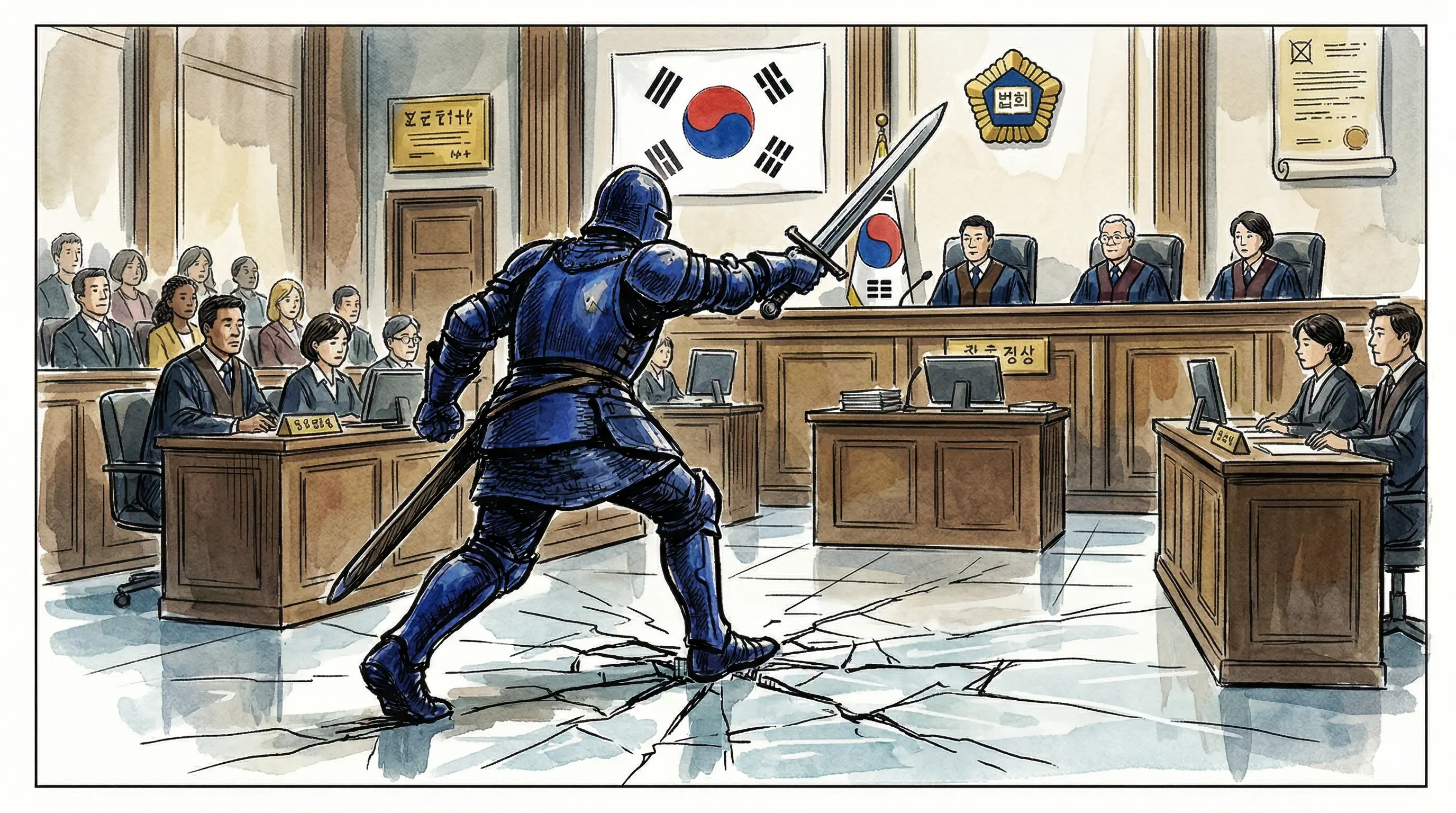
Unlike the original Crusaders, Minjoo has come close to actually retaking Jerusalem. The prosecutors are all but vanquished, and the judiciary is seemingly next. Yet the party remains unsatisfied, recently embarking on another bold campaign.
Last month, Minjoo launched a parliamentary investigation into several ongoing court cases, arguing that they were rigged by politically motivated prosecutors during the previous administration. Three of the seven targeted cases are directly related to Mr Lee. By law, using parliamentary probes to influence ongoing trials is strictly prohibited—but since when have crusaders cared about petty legality?
It remains to be seen how long this investigation will last before the Constitutional Court strikes it down, but it has already borne fruit: the birth of a social media star.
Park Sang-yong, the prosecutor who investigated an illegal cash transfer to North Korea involving Mr Lee’s confidant and a gangster-turned-businessman, decided to take matters into his own hands via Facebook. He has since been posting furiously, dismantling the absurdity of the Minjoo lawmakers’ claims. With every post racking up thousands of likes, the justice minister suspended him, and special prosecutors are now laying into him.
Minjoo’s argument regarding the case is an extension of the “salmon story“—the claim that Mr Lee’s confidant was coerced into fabricating testimony against Mr Lee (then governor of Gyeonggi province). Mr Lee insists his confidant approved the $8m cash transfer to Pyongyang entirely without his knowledge. Proving Mr Lee’s innocence in court, however, is now practically impossible, as the Supreme Court already found the confidant guilty as charged last year.
Minjoo’s apparent endgame is to force the justice minister to drop Mr Lee’s prosecutions altogether, once the special prosecutors obligingly conclude that the original prosecution is legally defective. In the Korean criminal justice system, a prosecution can only be cancelled before the first court ruling is issued. Because all three cases involving Mr Lee have been dragging on since before his election, they remain technically eligible for cancellation.
The funny thing about politics is that while absolute power can often seem capable of granting impunity, trying too hard to secure it usually triggers the exact crisis you were attempting to avoid—call it the Oedipus trap or the Streisand effect.
This very dynamic is why Minjoo failed to retain power under President Moon, and how President Yoon accelerated his own political demise. Will Mr Lee be the exception this time?