
Why it matters: President Lee’s press conference was meant to put a floor under his approval before Chuseok. It held for one day. With his ratings now below his own party’s and no national election for 18 months, Minjoo has both the motive and the time to keep its distance, and the right’s new front-runner has yet to show he can build anything larger than a headline.
Scripted Humility, Unscripted Contempt
Judged by the opening remarks alone, President Lee’s press conference on Friday was a conciliatory attempt to halt his plummeting approval ratings before Chuseok, the holiday when families gather, argue about politics, and reset public opinion.
But the gap in tone between his script and his answers suggests none of those words will translate into policy. Take his frosty dismissal of a journalist’s question about jeonse, Korea’s deposit-based rental system, now on the brink of extinction under Mr Lee’s housing policy. It is unnerving to watch.
이재명 : 모두 저의 부족함 때문입니다
— 여리 (@lifecollector77) September 18, 2026
국민의뜻을 겸허히 받들여 초심으로 돌아가겠습니다 기자 질문 받겠습니다
기자 : 대통령님께서 전세제도 서서히 '사라져야 할' 제도라고 했는데, 지금도 그렇게 생각하시는지 궁금합니다
이재명 : 사라질 것이라고 했지 내가 언제 사라져야 한다고… pic.twitter.com/j9zERHEeFO
His answer on who approved single-stock leveraged ETFs, which have since proved disastrous, displayed his worst self: patting himself on the back when things go well, dodging responsibility when they go bad. He said he did not know whose call it was. Who believes that of a president who finds time to comment on the arrest of a BTS ticket scalper?
The Floor Held for a Day
The press conference signaled no change in policy, but it might still have put a floor under his ratings, if not for what followed.
Kim Seung-won, the embattled justice minister nominee, threw in the towel the next day, saying he did not want to burden the administration’s reform agenda any further. Many observers were mystified: at the press conference, Mr Lee had appeared to leave the door open for him.
A revelation followed the same day. Several of Mr Kim’s former aides, not just one, had filed a petition detailing their former boss’s misdeeds, including drunk driving (again) and sexual harassment, with Minjoo and the Blue House on the very day the Minjoo-controlled judiciary committee adopted his confirmation report. According to reports, Mr Kim decided to quit only after meeting one of the former aides in person, who insisted they would go public unless Mr Kim withdrew.
Mr Kim’s exit will not end the pain. That Minjoo and Mr Lee pressed ahead despite the petition — and it is hard to believe they knew nothing, since the petitioners say other Minjoo lawmakers were present when the alleged harassment took place — shows how desperately Mr Lee wanted his prosecutions canceled.
At the press conference, Mr Lee asked the Assembly to strip the planned special prosecutor — the one Minjoo wants in order to investigate the Yoon administration’s “fabricated” prosecutions, Mr Lee’s own cases among them — of the power to dispose of those cases. He appeared to step back from having his prosecutions canceled.
But there is another route he did not mention. If the special prosecutor, yet to be appointed, concludes that the prosecutions were unjust, a justice minister could use their authority over cases to withdraw the indictments on the strength of those findings.
How Lee Myung-bak Came Back
There is a precedent for a comeback. If success means a sustained rebound and handing power to your own party, Lee Myung-bak is the Sixth Republic’s champion. Cho Gwi-dong, my favorite political analyst, details how he did it in his newsletter.
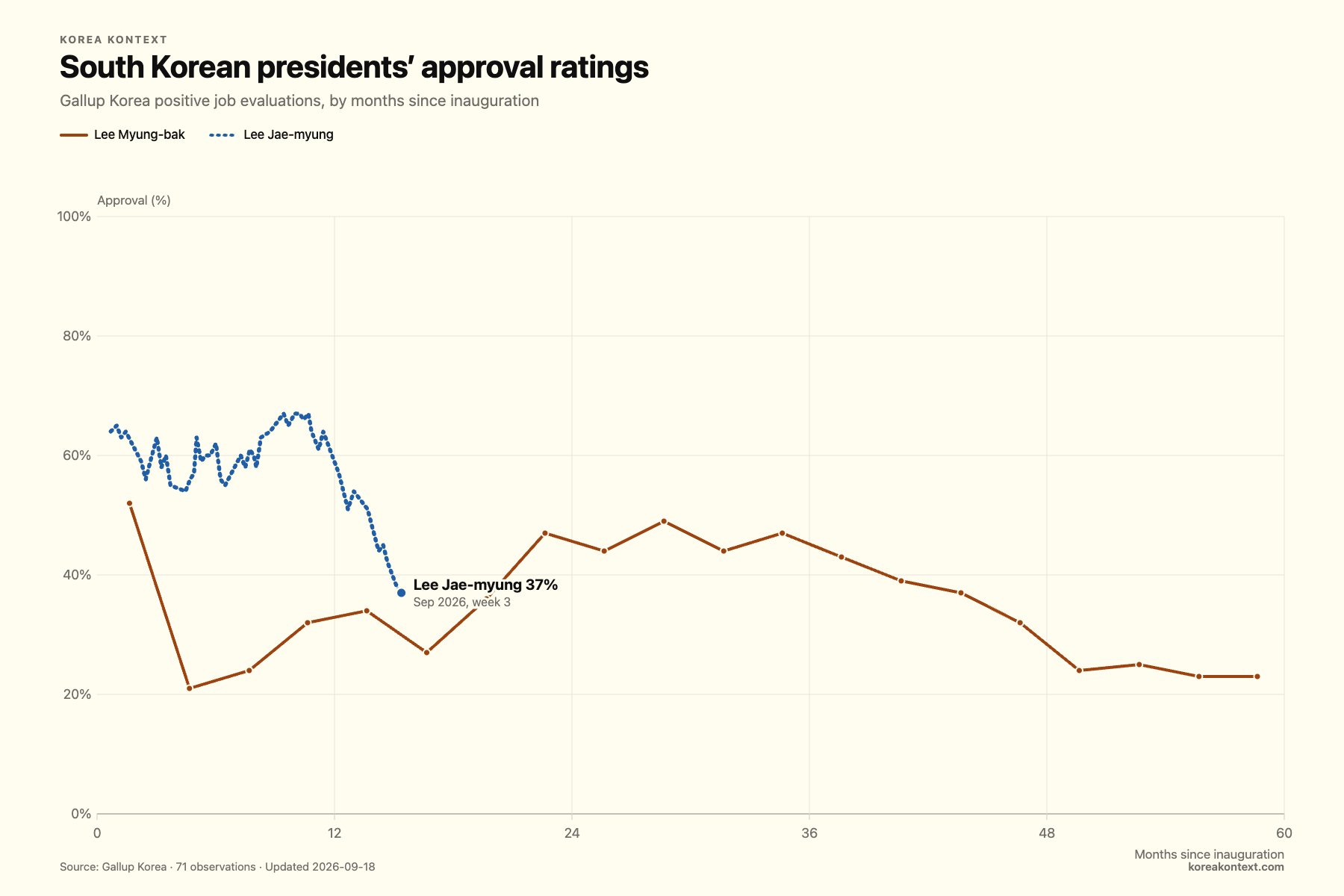
The 2008 protests over US beef imports sent his approval into the teens within three months of his inauguration. He climbed back in three stages. First, he steered through the 2009 global financial crisis well enough to cement his brand as the economy president: results on bread-and-butter issues. Second, in late 2009 he tacked left, putting pragmatic centrism and the working class up front and bringing in Chung Un-chan, an inequality-minded economist from Chungcheong, as prime minister. Third, right after losing the 2010 local elections, he seized progressive-friendly ground under the banner of a “fair society”: shared growth, an end to privilege. He rallied his base where he was strongest, then went after the center on the opponent’s turf. That is how his party kept the presidency.
Eighteen Months Without a Ballot
Things do not look good for Mr Lee. His approval now lags his own party’s, which means that if an election were held next week, Minjoo candidates would think twice before putting his face on their posters. Gyeonggi Governor Choo Mi-ae’s public revolt shows he is not even popular with the party’s hard core.
But there is good news for Mr Lee, too: there is no election for 18 months. His allies’ grip on the party leadership is secure for that long, since their terms are fixed, and anyone hoping to run for a seat in Yeouido will not dare cross a leadership that hands out the tickets.
Eighteen months is long enough to turn things around. But is Mr Lee capable of the kind of pivot Lee Myung-bak made? Having watched the press conference, I am skeptical.
The Biggest Winner Has the Harder Job
The biggest winner from Mr Lee’s disastrous reshuffle is Han Dong-hoon. The former PPP leader, expelled by the Yoon loyalists and elected as an independent in June, had no seat at the confirmation hearing, yet he commandeered the headlines with his sharp-tongued attacks on the nominee. An annual trust survey has found that Mr Han has overtaken Mr Lee as the country’s most trusted politician.
The current PPP leadership plainly cannot win an election. The open questions are how the right gets rebuilt and who leads the rebuilding. Mr Han is the front-runner, but I cannot see how he persuades the Yoon loyalists to join him. Running and winning as an independent showed far more potential than I had expected; eviscerating opponents, however, has come more easily to him than rallying allies to a larger cause.
Seoul Mayor Oh Se-hoon is better placed than Mr Han: he is a card-carrying member of the party, and he has benefited from the Lee administration’s failure on housing. For all his experience, though, he has a habit of making bad decisions at critical moments.
Lee Myung-bak’s comeback began with a change of course. Friday showed a president who thinks the course is fine and the public is misinformed. That is not how comebacks start.