
Why it matters: President Lee’s public feud with Kyiv says less about a broken confidentiality pledge than about a president who, with his ratings sinking, has switched off the autopilot that kept Seoul’s diplomacy on its default, Western-aligned course. His ministers still sign the standard statements, but his own words now point toward Pyongyang, and perhaps Moscow.
Manual Override
This newsletter has long worried that President Lee Jae-myung’s personal views on world affairs are alarmingly narrow. On the campaign trail in 2024, he asked why Korea should needle China: “Just say xie xie [thank you], and xie xie to Taiwan too.” The day after Russia invaded Ukraine in 2022, he called Volodymyr Zelensky a “six-month novice politician” who had provoked Russia by vowing to join NATO. (He apologized the next day, blaming his “insufficient expressiveness.”)
Contrary to my fears, Mr Lee kept Seoul on its default diplomatic course from the start of his term until quite recently, as this newsletter has also noted more than once. Lately, though, Seoul’s diplomacy has slowly begun to break away from that default and from the Western standard it tracks. The spat with Ukraine is the clearest case so far, and Mr Lee is making it worse with unfiltered posts on X — a relapse into his old, vitriolic self. Perhaps he has had too much time on his hands since returning from his week-long trip.
The facts first. Mr Zelensky told the UN General Assembly on September 23 that Ukraine had sent two North Korean prisoners of war to South Korea. Mr Lee, then in Mexico, wrote that it was “very regrettable” that Kyiv had broken an agreement to keep the transfer confidential. Kyiv replied that there had been no such agreement. Seoul demanded an apology and summoned Ukraine’s chargé d’affaires; Andrii Sybiha, Ukraine’s foreign minister, called it a “diplomatic misunderstanding” he hoped to resolve soon.
That was not enough. On Friday, Mr Lee accused Ukraine of “attempting to spark a war on the Korean Peninsula” and threatened “additional measures” unless it acknowledged the agreement and apologized publicly. He appeared to be referring to Kyrylo Budanov, head of Mr Zelensky’s office, who had said it was “only a matter of time” before an incident on the inter-Korean border triggered “uncontrollable consequences.” That is a bleak forecast, not a plot.
Given how sensitive it is to bring North Korean prisoners of war to the South, Seoul’s demand for confidentiality is perfectly understandable. Publicity can put lives at risk, as Mr Lee has argued, and make future transfers harder. But the negotiations themselves were no secret. Seoul’s foreign ministry said on the record in June that it was in talks with Ukraine, and Mr Sybiha posted about discussing the issue in Seoul a week later. Against that backdrop, it is puzzling to see a head of state vent his displeasure this loudly.
It is also hard to square with his silence on Pyongyang. On Monday, the military concluded that the mines that seriously wounded three South Korean soldiers last month had been laid by North Korea on the southern side of the border, and demanded an apology from Pyongyang. Mr Lee, who spoke of “an unforeseen accident” in his Armed Forces Day speech last week, has yet to say a critical word about the North. He demands a public apology from Kyiv over an indiscretion, but none from Pyongyang over the mines.
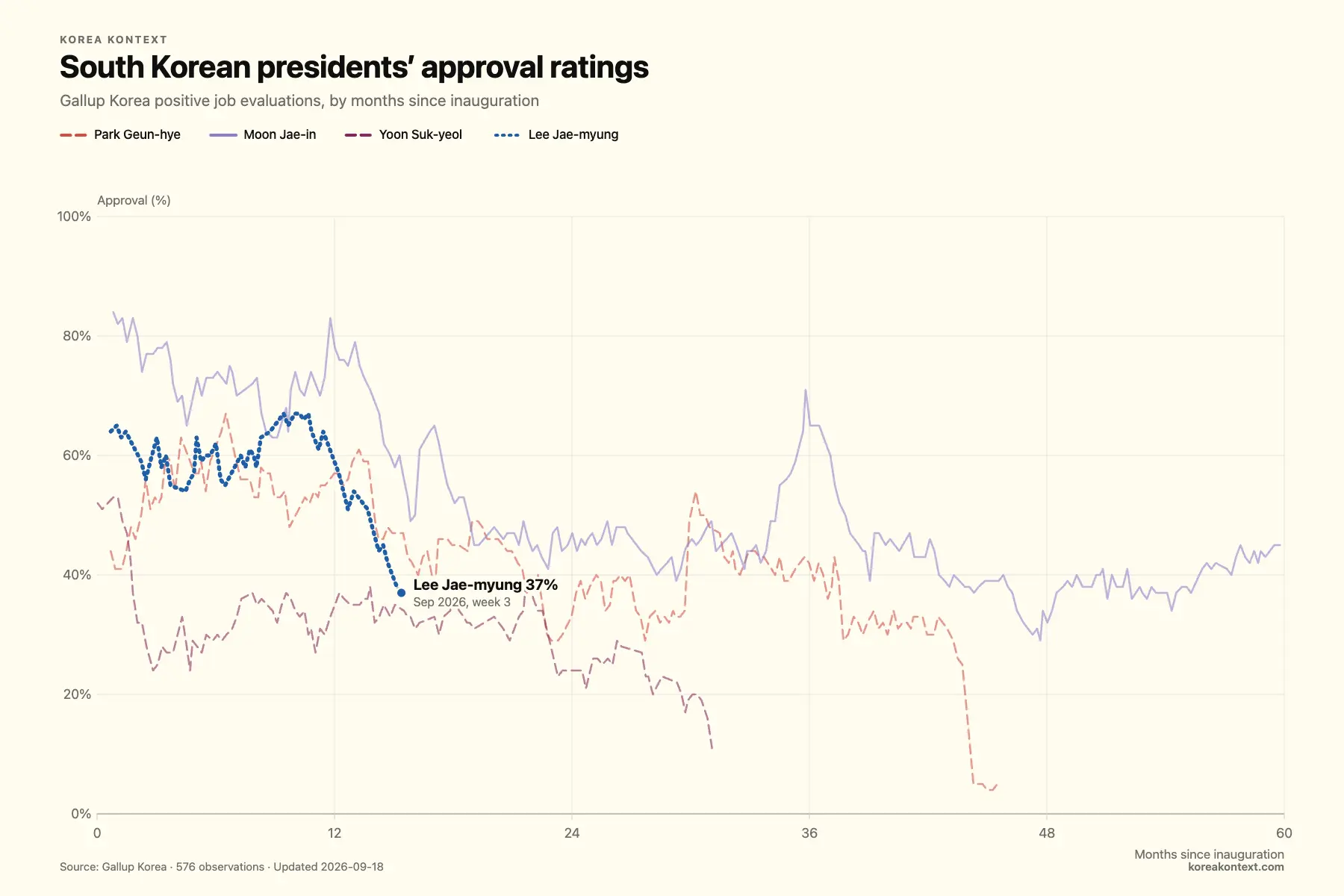
What is happening? My hypothesis is this. While his approval ratings were healthy and no serious conflict had surfaced, Mr Lee could leave Korea’s diplomacy on autopilot, flying the traditional default course. Now that his ratings are in crisis — Gallup put his approval at 37% before Chuseok, the lowest of his term — and conflicts have broken into the open, he has switched off the autopilot and overridden it with his own long-held worldview and the advice of his inner circle.
Nothing illustrates this better than the gulf between what Seoul signed and what Mr Lee said in New York last month. On September 21, Foreign Minister Cho Hyun readily joined his American and Japanese counterparts in a joint statement reaffirming their commitment to the “complete denuclearization” of North Korea and opposing “any attempts to unilaterally change the status quo” across the Taiwan Strait. The next day, Mr Lee’s address to the General Assembly did not mention denuclearization at all. Instead, he proposed first halting the North’s nuclear and missile advances, then reducing them, and “in the long term” moving toward “a Korean Peninsula without nuclear weapons.” (The presidential office insists the two phrases mean the same thing. Then why swap them?)
In an interview with The New York Times, published the same day as the joint statement, he went further, proposing to trade sanctions relief for a halt to the North’s development of additional nuclear weapons and intercontinental ballistic missiles. Insisting on denuclearization now, he said, “guarantees that nothing will be accomplished.”
If my default-versus-override hypothesis holds, the spat with Kyiv is less about what we see on the surface than about laying the groundwork for better relations with Russia.
The Northern Route
Other moves point the same way. On Thursday, the day before his outburst, Mr Lee appointed Song Young-gil, a former Minjoo leader and the party’s best-known Russia hand, as his special adviser for peace diplomacy. Mr Song speaks Russian, served as Moon Jae-in’s special envoy to Moscow, and holds an Order of Friendship from Vladimir Putin. The next morning, he was on the radio saying that the president was “quite angry” and that recalling Korea’s ambassador to Kyiv would be the next step.
Mr Lee has also cheered a Busan ship’s pioneering voyage along the Arctic shipping route in several posts on X, promising to “bring forward the Arctic route era.” (The route, which runs along Russia’s Arctic coast and opens fully for only a few months a year, can do little for Korea’s trade: Coface, a credit insurer, estimates that just 3.5% of current traffic between East Asia, northern Europe, and North America could shift to Arctic routes.)
Even some of Seoul’s most Western-friendly diplomats now reckon that Russia offers better prospects than Ukraine once post-war reconstruction begins. Part of the reason could be that Ukraine’s reconstruction and its joint defense-technology projects appear to revolve around Europe, leaving Korea on the sidelines. At bottom, though, this is Seoul’s foreign policy NIMBYism at work. Having shown little interest in Ukraine and let its opportunities there slip, Seoul is now turning its eyes to Russia, where the field looks empty. (Pro tip: It is empty for a reason.)
Kyiv’s fatal mistake was to assume that Seoul would be desperate for its experience of fighting North Korean troops. It appears to have played hardball on that assumption. But one of the key figures in Mr Lee’s government is his old mentor, Unification Minister Chung Dong-young, who reportedly objected at a National Security Council meeting last week when the foreign ministry proposed unilateral sanctions on the North’s cyber operations in response to the mine blasts. Kyiv was offering lessons in fighting North Korean soldiers to a government that cannot agree to sanction North Korean hackers.
Assassin(s): Whose Speech Is Free?
The row over Assassin(s) shows, once again, how strong the cultural left remains and how far behind it the right lags.
Hur Jin-ho’s film, which hints that the KCIA, Park Chung-hee’s spy agency, may have been behind the 1974 shooting that killed First Lady Yuk Young-soo, has sold more than 2.4 million tickets since opening over Chuseok. When right-wing YouTubers are reduced to urging their viewers to go and see Chiikawa, a Japanese cartoon about tiny, cute creatures, the culture war is not going well. (Chiikawa did top the box office on two days, though its presales were booming before anyone thought to politicize it.)
The film’s narrative is poorly structured, but a poor film is no reason to curb free expression. The PPP nonetheless tried to call Mr Hur before the parliamentary audit, and a former PPP Seoul city councilor filed a criminal complaint against the filmmakers for defamation. Even Seoul Mayor Oh Se-hoon of the PPP, no fan of the film, warned that the more politicians pile on, the more attention it gets. The right is handing a mediocre film the kind of noise marketing money cannot buy.
The real social impact, however, will fall on young people who see a double standard in how their elders treat this film and how they treated Starbucks. In May, Starbucks Korea promoted “Tank Day” tumblers on the anniversary of the Gwangju uprising. Mr Lee demanded “moral, administrative, legal, and political responsibility”; the chief executive was fired that day, and police later raided the company’s headquarters. High school baseball players who chanted “Tank Day” at a game against a Gwangju school were suspended from competition. Small wonder that, as soon as the film’s premise became known, many asked whether a film pinning Roh Moo-hyun’s death on those closest to him would pass as free expression, and noted that a single falsehood about Gwangju can carry up to five years in prison.
The film will leave theaters in a few weeks. The lesson young Koreans are drawing about whose speech is free will linger much longer.